Nadav Kander’s Commentary On The State of Symbolism and The Human Mind
1. The Pause
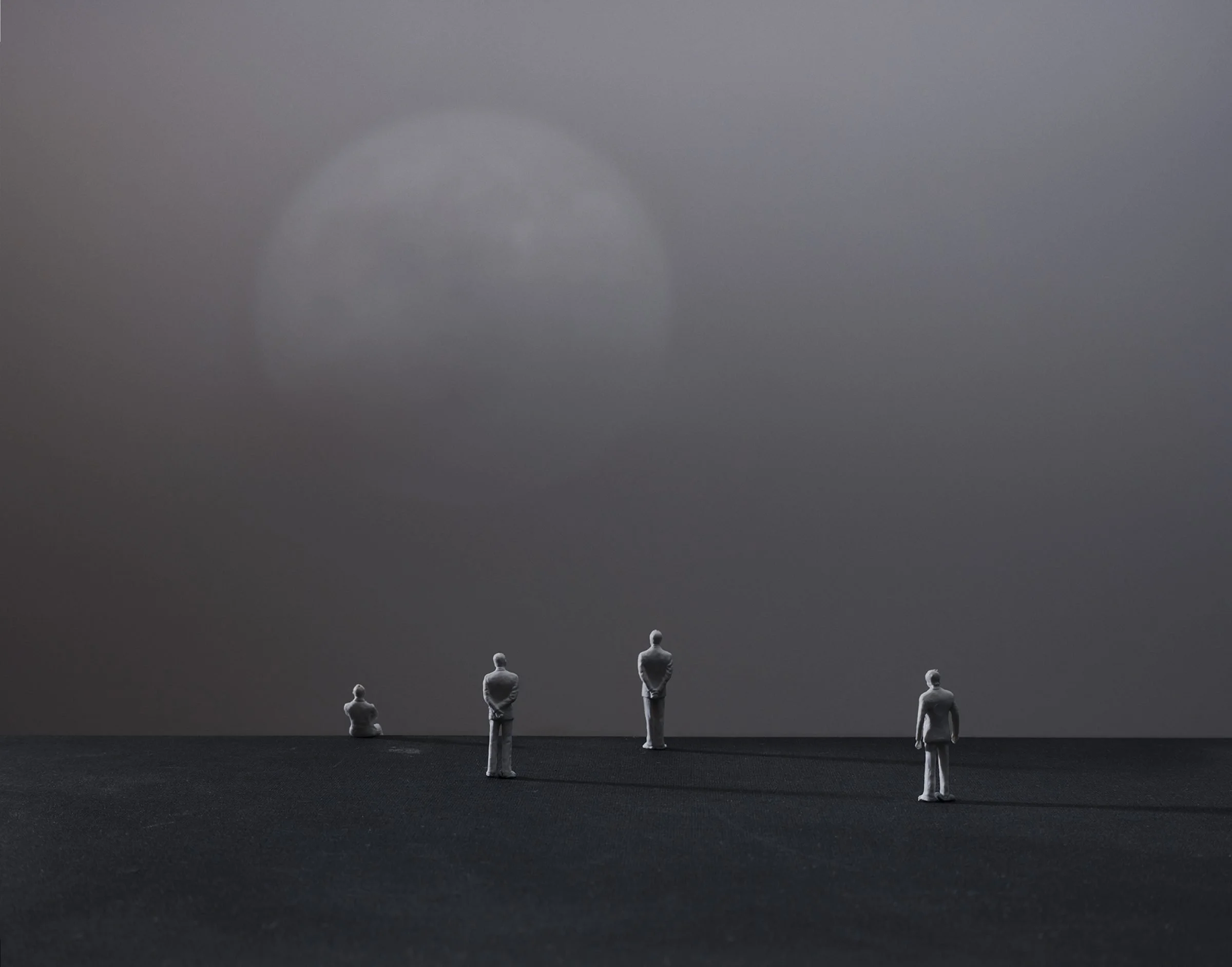
Untitled VI, Nadav Kander. 2020
“Some occasions or occurrences in my life present themselves in a way that, if not ignored, inform me as to how I tick, what is fundamental to me. What it is I constantly strive to grasp and express. It has the effect of bringing understanding to that that is intuitive.
At the point this lockdown began, I was no stranger to solitude and the effect it has on me and my practice as an artist. When we separated ourselves, I was very aware of the feelings that arose in me from the forced distancing and shocked at how quickly my surroundings, which were until that moment a safe place, became quickly alienating and unsafe to me. Another human being becoming a threat, an enemy, a carrier of a deadly disease. I began thinking about the importance of touch to non-verbal communication and how the lack of it would produce a yearning for connection. My knee-jerk reaction was to go to my studio and riff off these feelings, which I tried but then resisted knowing the knee jerk in my case always results in work of little value.
Weeks later I began again. This is work with the guts of solitude, melancholy and longing which bring up feelings of both beauty and terror.
I think of a quote by Rilke: “Love your solitude and try to sing out with the pain it causes you.” So many feelings are at play and I was aware that in this quiet time there was a much bigger picture playing out, and it will continue to play out in our future.
As a child growing up in Johannesburg, South Africa, we had no TV. I had an electric train set that was made in Germany where my father was born. It was set out on a spare dining room table. No hills or tunnels, just a figure of eight with a station. There were small human figures dotted about, who with my imagination performed many duties depending on how I saw my mini world that day.
In my studio I have many items on shelves that, out of context, are odd, causing to arise a mildly uncomfortable feeling in a viewer. Animal skulls, dolls, wigs, porcelain flowers, crucifixes and small humans, some from my train driving days.
These folks performed once again for me and mirrored back at me the feelings of Solitude – Quietude – Contemplation that I felt most strongly in the first days of lockdown. The feeling of the unknown.
It seemed not by chance that the Royal Academy show of Leon Spilliaert was opened just before the lockdown. The painter wandering alone at night near the water’s edge in Ostend and bringing his memory into the studio to paint the feeling as much as the scene he had just experienced.
This series of work I hope brings up feelings of isolation, distance and contemplation in a viewer as well as a realisation that this time in history is bigger than just this virus. That it holds potential in its invitation to consider that this event is willing us human beings collectively to move towards balancing our indiscriminate use of nature’s resources. This is not a warped reality, it is just reality, and it comes out of man being out of balance with nature.”
What strikes me about this project is the lack of urgency from Kander. Some may see this as a negative in an artist but the result of his patience is rewarded with a powerful message as the outcome. Kander describes acting on instinct produces negative outputs from his work which is commendable and understandable, yet it’s his peace in an uncertain time to wait that highlights his proficiency as not just an artist but also as a student of life. When COVID hit, he identified that this was a point in history that would be learnt about for years to come so his mark on that point in history needed to be perfect, not just for his own legacy but as a historical archive of mental health, represented through photography during a global pandemic. His use of isolated figurines in imagined worlds with lots of negative space touches on his own history of living with mental health issues and fear of living in isolation, yet he manages to compound this in such a relatable way that many people would’ve been feeling during the pandemic.
2. Dust
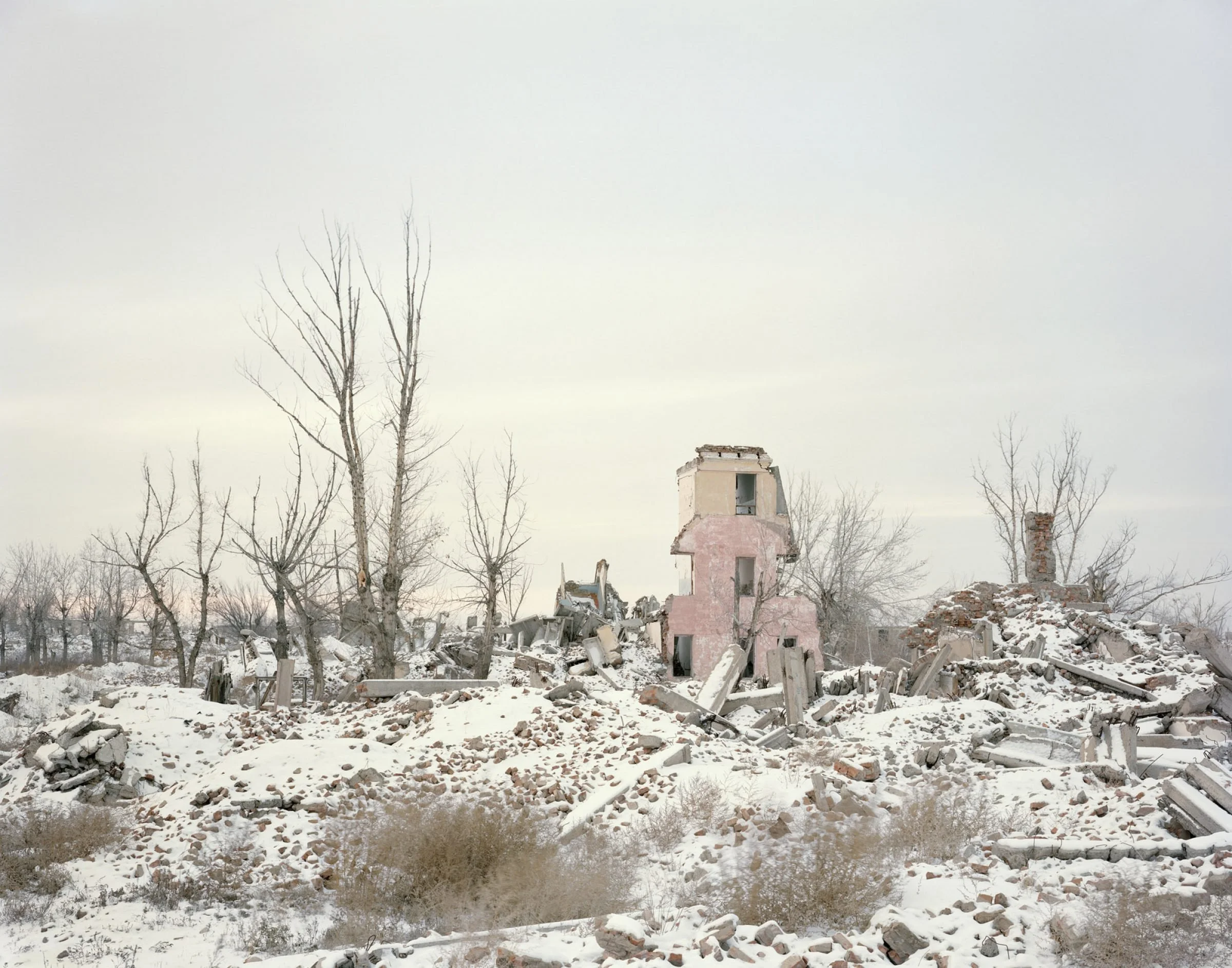
Kurchatov I, Nadav Kander. 2011
“The crows stand witness to the havoc wrought by mankind. Found in folklore and mythology the world over, the crow evokes a visceral response in me, a feeling of anxiety. They have long been associated with the dark side of the subconscious and the underworld, often considered a harbinger of death or bad fortune. Some believe that they bring messages from the divine, and others that they are our ancestors. I saw these crows as we approached the area known as The Polygon (an atomic test site). Their nests looked like blocked arteries in the trees. The only sign of life. As they circled above us, I felt a sense of brooding unease.
I later discovered that after each detonation in The Polygon there would be a flash, which would scare all the birds into flight, and the ensuing heat would burn their feathers. The Russians’ notes from these tests mention that hundreds of crows and other birds were burned alive. Some had their feathers singed and were no longer able to fly. They could be found squawking on the ground, drowned out only by the sounds of the tethered animals that were being monitored as they died. But despite this, the crows are still present.
While researching large cities in Russia with a view to starting a photographic project, I came across two smaller towns that had been kept secret: Kurchatov and Priozersk (formerly known as Moscow 10). These places on the Russian-Kazakhstan border never appeared on any maps until Google Earth ‘discovered’ them. I was told that these towns were mostly destroyed. As with many secrets in life, this inspired my wish to know more, and I was propelled by that desire as well as an interest in the aesthetics of destruction. This fascination then took me from East Kazakhstan to the desolate Aral Sea.
Ruins conjure paradoxical emotions. We are at the same time frightened and mesmerised by destruction, as we are by death. And without being fully aware of what is pulling me, I am continually drawn to explore this theme; the darker side of our nature, of mankind. I find the ruin, in its many guises, beautiful, as have many artists before me. But it is the combination of beauty and destruction, beauty and melancholy, that really attracts me. When these two things come together, something happens, regardless whether I am working with people or landscapes. I do not fully understand it. I see space in my work; I think of a wide expanse, and I begin to see things in the periphery of my vision. As if I am falling into my subconscious. I find it hard to find the words to describe or fully grasp this feeling, but I know that when a recipe combining these two elements comes together, something more is created; a mixture of beauty and truth. This is what I am searching for in my work.
The Cold War and the relentless quest for nuclear armaments created many of the ruins that we see here, and they now stand as monuments to the near ruin of mankind. I wonder, when does a ruin become aesthetic? Must nature first soften the brickwork? Ruins hold within them the layers of time. But at what point does the newly destroyed become a ruin of the past?
When you are there, these places seem empty and silent. I was photographing destroyed landscapes without any clue as to how inhospitable they were to man—apart from the white overalls we had to wear. The Geiger counters brought from the UK chattered away on our belts, keeping us from the worst of the invisible dangers. As I pondered these burnt and fallen ruins—edifices that had been built specifically to test how much they could stand—I was reminded of Albert Speer’s notion of ‘ruin value’, the idea that buildings should be designed to eventually fall into aesthetically pleasing ruins, demonstrating to future onlookers the might of previous generations. When Sir John Soane designed the Bank of England, he presented the governors with three oil sketches, the third of which showed how beautiful the building would look in ruins—a thousand years onward. I wonder how the ruins we see here on these pages will speak to future generations.”
The fact that Kander is responding to real life events with this project makes it all the more interesting. Firstly, his mention of crows and how they give him anxiety is all too known to many as crows are often depicted in the media as beacons of death. Plenty of movies have shown them picking at human corpses and flying in melancholic locations. Their symbolism is with death and misfortune which Kander gives permission to spill into the natural world. It’s no coincidence when the interpretations and themes of the crow are connected to them existing in a place that has caused destruction for humankind, with innocent people usually baring the brunt of mistakes made by the elite and/or greed. His description of the Russians burning the crows with their tests can be seen as humanity fighting back against the idea of death and not fearing death - however, because the site is abandoned now, this theory doesn’t hold up especially well as the crows, who are the symbolism of death according to Kander, are the only active residents now. How the crows died during the radioactive tests is more of a commentary on the negative impact that humans are having on the natural world and how we are causing problems for the natural world in the pursuit of weapons and mutually assured destruction of each other. As touched on already, this constant need for one-upmanship on the rest of humanity impacts those who are innocent and have no desire in conflict. This is a landscape that has been destroyed for humanity’s gain and many other landscapes are at threat - such as Dartmoor and, for the sake of my narrative, the dystopia that the wanderer lives in.
