Geomancy: Decrypting Our Connection To Nature
Article Courtesy of The British Journal of Photography (12th December 2019)
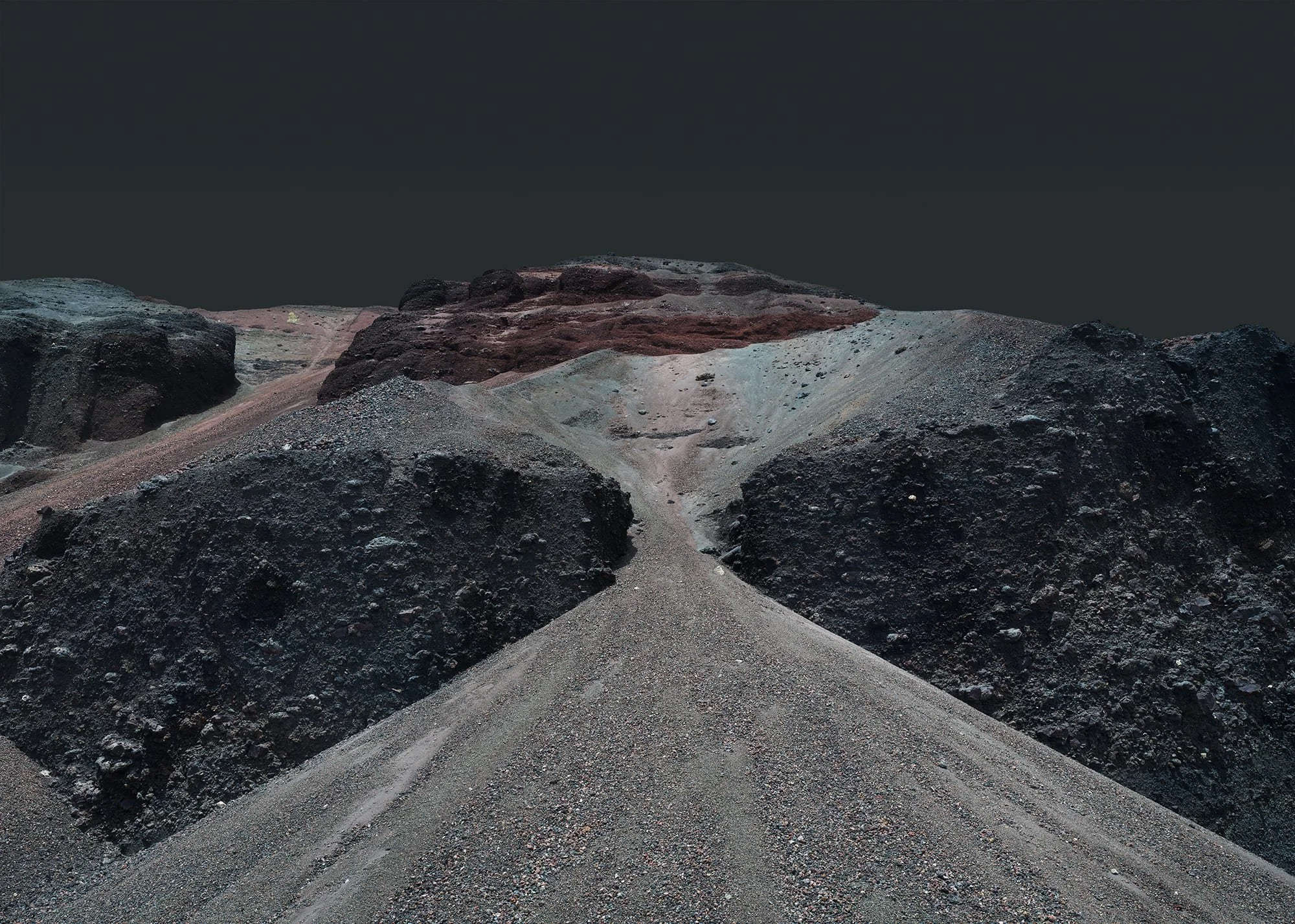
Michael Lundgren’s third photobook transports us to ethereal landscapes, but what do they say about our own reality?
The title of Michael Lundgren’s latest photobook, Geomancy, refers to the occultic method of interpreting sedimental markings and patterns on the ground. But, like the method of divination, from which it takes its title, the book is devoid of factual statements: there is no text or allusion to time or place. The book comprises a sequence of strange structures in mutant landscapes, and colours, which, surely, do not exist in the “real world”? So where are these places, are the alien forms symbolic, and what do the images say about our world and our reality?
“This book is interested in the psychic space that’s created by photographs,” says Lundgren, explaining that although some of the colours are manipulated, he considers the images to be rooted in the real world. “It refers to our own experiences or visions of the earth, but does not point to any particular landscape, region, or ecosystem.”
Geomancy follows on from Transfigurations (2008) and Matter (2016) and is an extension of the photographer’s continued interest in mythology and surrealism. Lundgren’s earlier photographs are stark and devoid of human elements, but more recently, he has been contemplating the changes in the way humans interact with nature. We were once a species that fed solely off the land, using its cycles as a guide. “We live in a world where nature is something outside of ourselves and now we’re trying to control it and save it,” says Lundgren. “For me, the larger impulse is to understand that forced separation from nature. Not just in terms of our physical lives but our spiritual lives as well.”
In order to obtain his shots, the photographer travelled through deserts in the Middle East, scaled mountains in North America and climbed into impossibly tight caves in Mexico, but for Lundgren, the geography and process are not what are important — “Sometimes work gets cast in the light of how difficult it was to make. That is a romantic notion,” he says.
Geomancy is a thought-provoking exercise. It is exactly this detachment from our world that prompts us to question our role within it. We can either choose to marvel at its celestial landscapes, or we can confront what this tells us about our relationship with nature as an ethereal concept. “This is not a climate peril book, but it is a natural peril book,” says Lundgren. “It’s this feeling that we are separated, and I want people to feel that, maybe through the insanity of my pictures.”
