Zanele Muholi
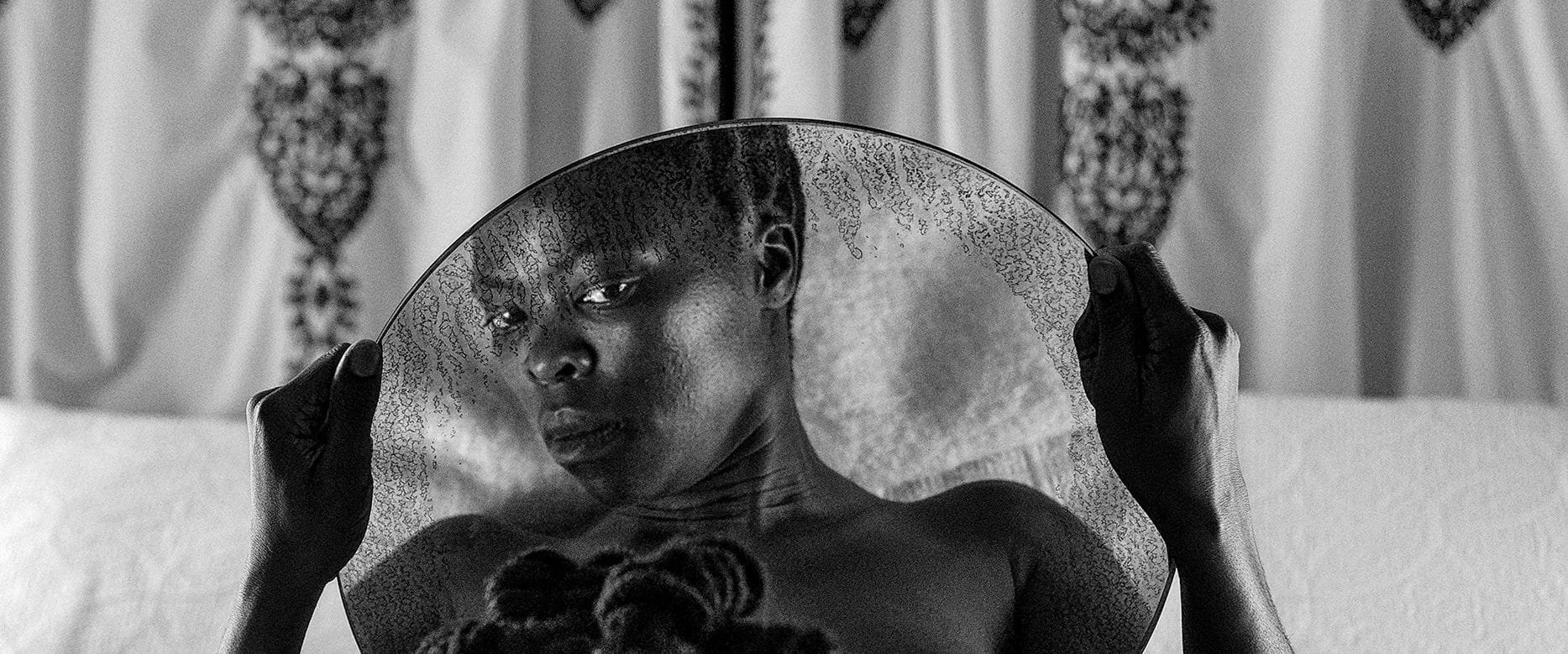
Zanele Muholi, courtesy of Zeitz MOCAA
Muholi describes themself as a visual activist. From the early 2000s, they have documented and celebrated the lives of South Africa’s Black lesbian, gay, trans, queer and intersex communities. Her works aims to establish an archive of LGBTQI individuals, “to re-write a black queer and trans visual history of South Africa for the world to know of our resistance and existence at the height of hate crimes in South Africa and beyond.”
In the early series Only Half the Picture, Muholi captures moments of love and intimacy as well as intense images alluding to traumatic events - despite the equality promised by South Africa’s 1996 constitution, its LGBTQIA+ community remains a target for violence and prejudice. In Faces and Phases each participant looks directly at the camera, challenging the viewer to hold their gaze. These images and the accompanying testimonies form a growing archive of a community of people who are risking their lives by living authentically in the face of oppression and discrimination.
Other key series include Brave Beauties, which celebrates empowered non-binary people and trans women, and Being, a series of tender images of couples which challenge stereotypes and taboos.
It was Muholi’s ability to tell a story in purely black and white that inspired me to write about her work. Traditionally, colour is an excellent tool when it comes to photographs depicting identity as we see factors such as environment and clothing as we would see it to give us clues into who the subject is. However we get none of that here which means we have to rely on other cues such as facial expression, stance, and clothing style rather than colour. Her work is a beautiful reflection of the LGBTQIA+ Black community which invites people to dissect the images in an open manner that reflects the times we’re living in. The world is debating more about both communities and their rights (LGBTQIA+ and Black) with some being negative and other debate positive. Muholi is able to present these individuals in a way that the audience considers what it might be like to be in these people’s shoes. I am a straight white man from England - miles away on paper from the Black LGBTQIA+ South African community in Muholi’s images - but seeing some of these in print transported me out of my bubble and put me face to face with people facing struggles worlds away from my comfort zone. Nobody should be persecuted for who they are, whether you agree with their lifestyle or not, and Muholi presents this argument in a convincing way without having to even use words to argue this.
