Richard Long’s Land Art Approach Revolutionised Dystopia
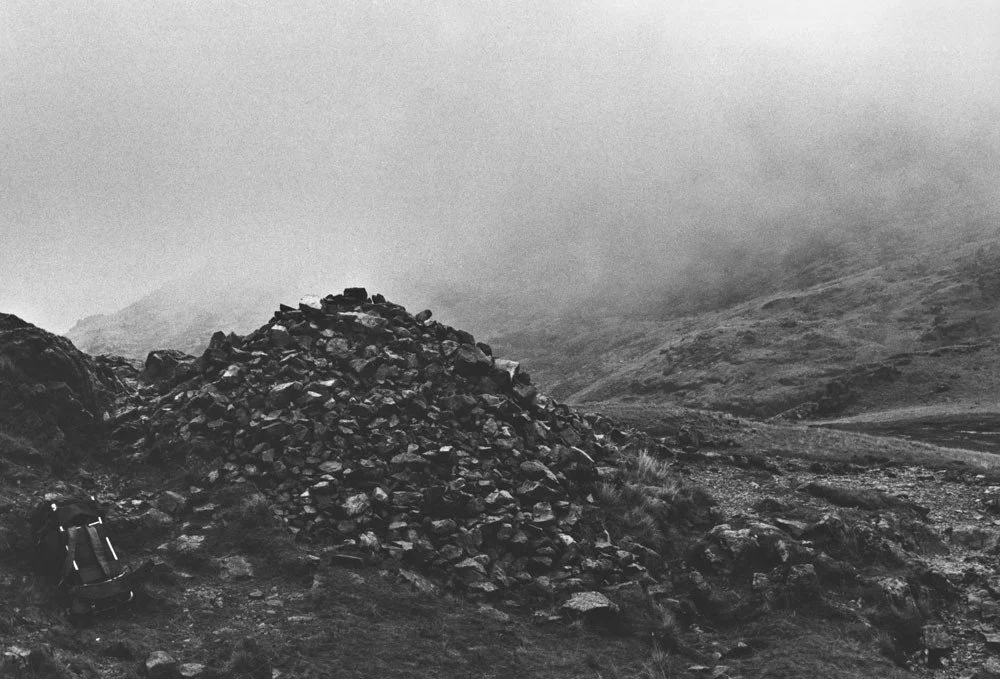
“Nature has always been recorded by artists, from prehistoric cave paintings to 20th Century Landscape Photography. I too wanted to make nature the subject of my work, but in new ways. I started working outside using natural materials like grass and water, and this evolved into the idea of making a sculpture by walking. My first work made by walking, in 1967, was a straight line in a grass field, which was also my own path, going ‘nowhere’. In the subsequent early map works, recording very simple but precise walks on Exmoor and Dartmoor, my intention was to make a new art which was also a new way of walking: walking as art.”
In the late 1960s, artists in the UK and US left the studio to go into the landscape, creating radical new forms of art that came to be known as ‘Land Art’. This approach to making included a range of practices, including sculpture and performance, nearly always recorded and shared through photography. Artists designated walks and ephemeral objects placed in the landscape as art. Landscape became subject, studio and inspiration.
Richard Long is one of the UK’s most significant artists. He has been at the forefront of contemporary art forms for over 40 years, pioneering new art forms through an exploration of landscape as both the medium and subject of his work. Long has stated that it was intention ‘to make a new way of walking: walking as art.’ He manifests the walks as art in 3 ways: in maps, as photographs, or as text works.
Long’s early Dartmoor walks are emblematic of the new art of mixing outputs. The same year that Robert Smithson, hired earthmovers to create Spiral Jetty on the Salt Flats of Utah, Long was walking ‘as art’ across Dartmoor. Despite his resistance to any artistic categorisation, Long has been described as a Land Artist ever since and has risen to international prominence, making work on Dartmoor throughout his long and prestigious career.
I first experienced Long’s work at the Dartmoor: A Radical Landscape exhibition and it completely changed my perspective on the entire project. By focusing solely on photography I realised just how much I was limiting myself and operating with one hand tied behind my back. The project was as much about exploration and walking as it was about photography and it felt like I had neglected this in my proposed outcomes from the brief during my Masters degree. There was more value in telling the story of the journey through multiple mediums so I introduced a basic form of mapping where I would draw a line of the route I’d taken, which soon advanced into an app on my Smartwatch that mapped the route for me. Highlighted below are some of Richard Long’s works that caught my eye.
1. Dartmoor Walks
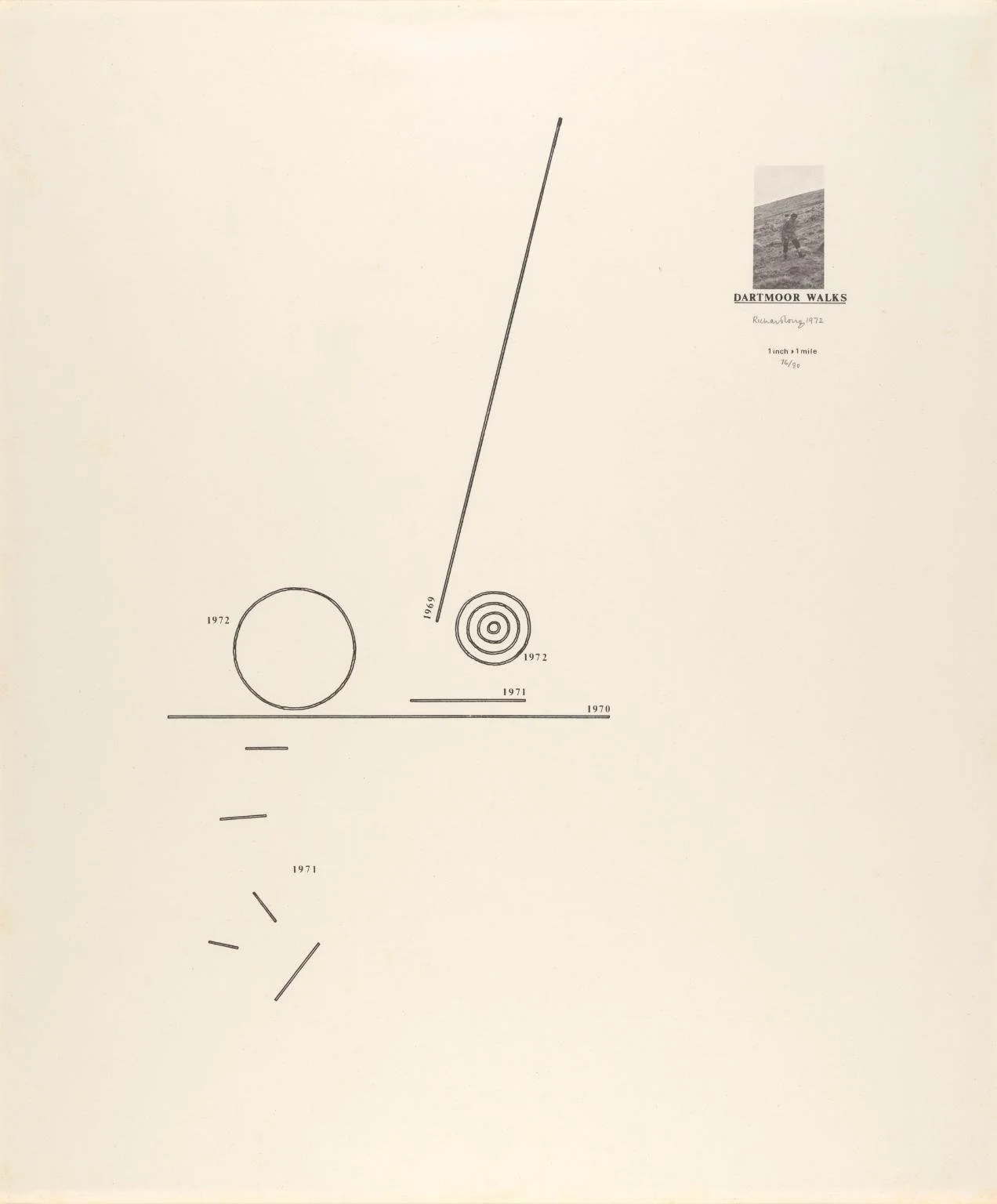
Dartmoor Walks, Richard Long. 1972
The image records all the walks Long had made on Dartmoor in one year. It doesn’t show or describe the different types of artworks he made on these walks but instead records their locations. The lines correspond to the location of each walk as seen on a 1 inch : 1 mile Ordanance Survey. Richard Long rarely makes prints; the one on display at RAMM was made for sale to friends of a museum in Monchengladbach, Germany.
2. Stones on a Cairn
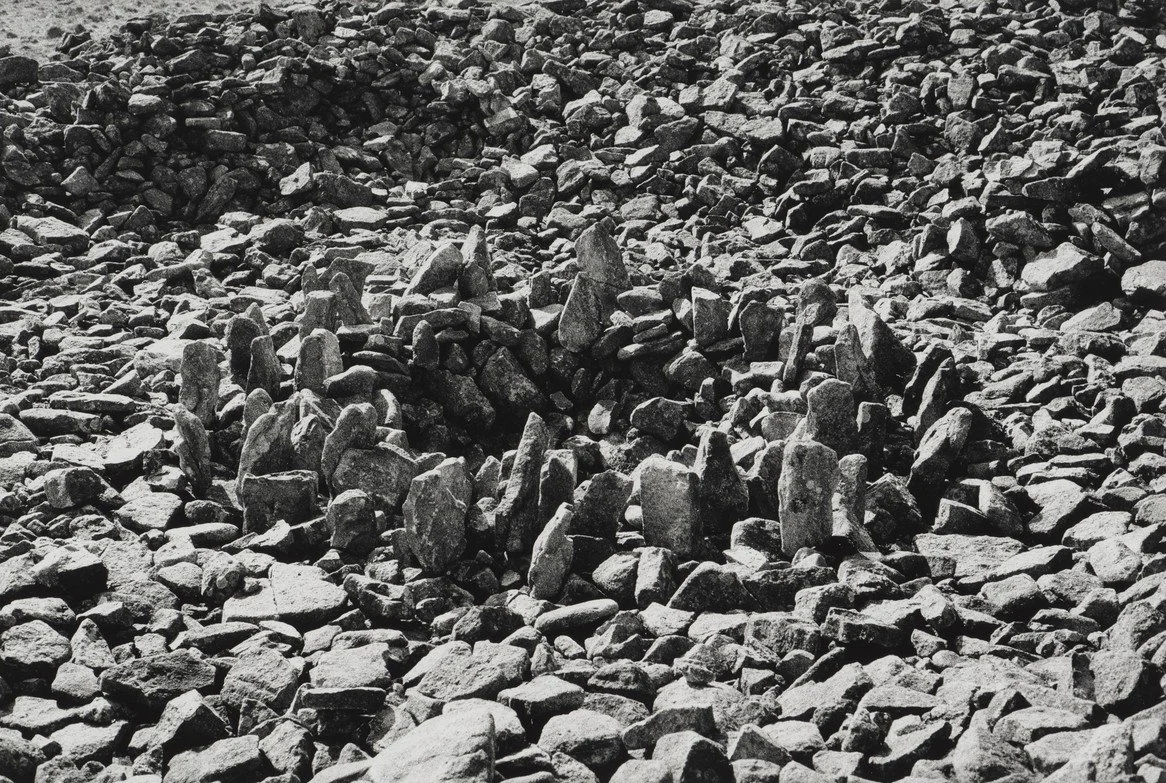
Stones on a Cairn, Richard Long. 1992
Although Richard Long’s work has become emblematic of Conceptual and Land Art, an element of ritual and pilgrimage is evident in his regular, repeated Dartmoor walks and the placing of stones as part of his art. This photograph documents both a temporary sculpture in the Dartmoor landscape, and when paired with Long’s text is its own distinct artwork.
Of his many varied sculptures in the landscape Long says, ‘Over the years these sculptures have explored ideas of transience, permanence, visibility and recognition. On a mountain walk a sculpture could be made above the clouds, perhaps in a remote region, bringing an imaginative freedom about how, or where, art can be made in the world’.
3. Life Death
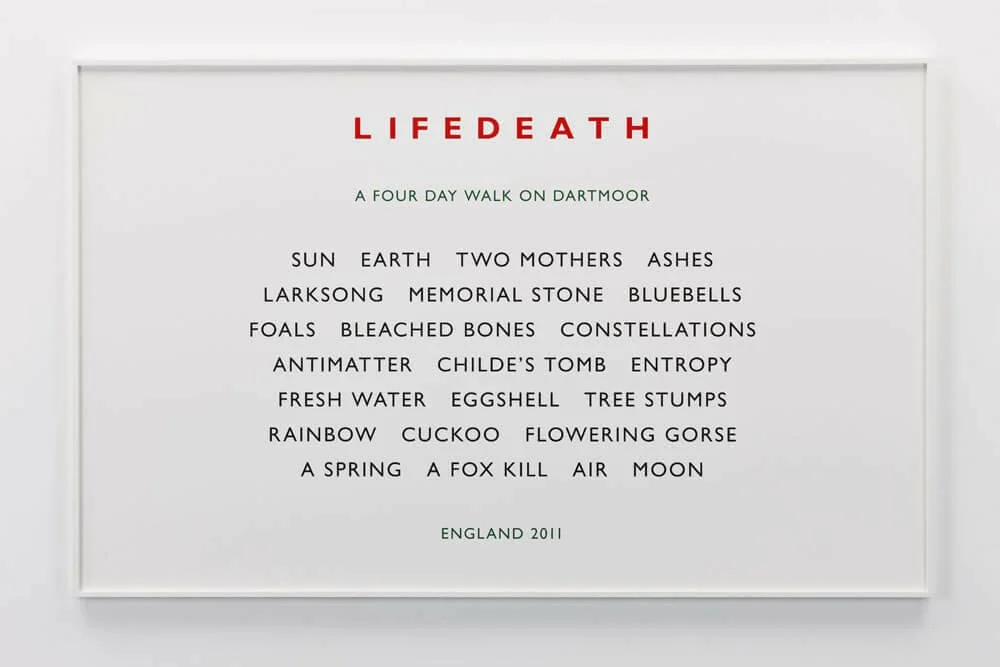
Life Death, Richard Long. 2011
Text has consistently featured in Richard Long’s art as part of a preoccupation with the physical engagement of his body in the landscape. He describes working in text as ‘narratives of walks and narratives of sculpture’. In Life Death the selection of particular observations from this four-day walk on Dartmoor with attention given to the words’ meanings, their juxtaposition, and the leap from the specific such as ‘bleached bones’ to the universal ‘air’ share formal qualities with concrete poetry.
By describing the text works as conveying a ‘sort of story’, Long’s observations in this Dartmoor landscape ‘function as resolutely reflexive indexes of being-in-the-world’ prompting images in the viewer’s mind.
