Marc Wilson’s Beautiful Requiem to the Landscape of War
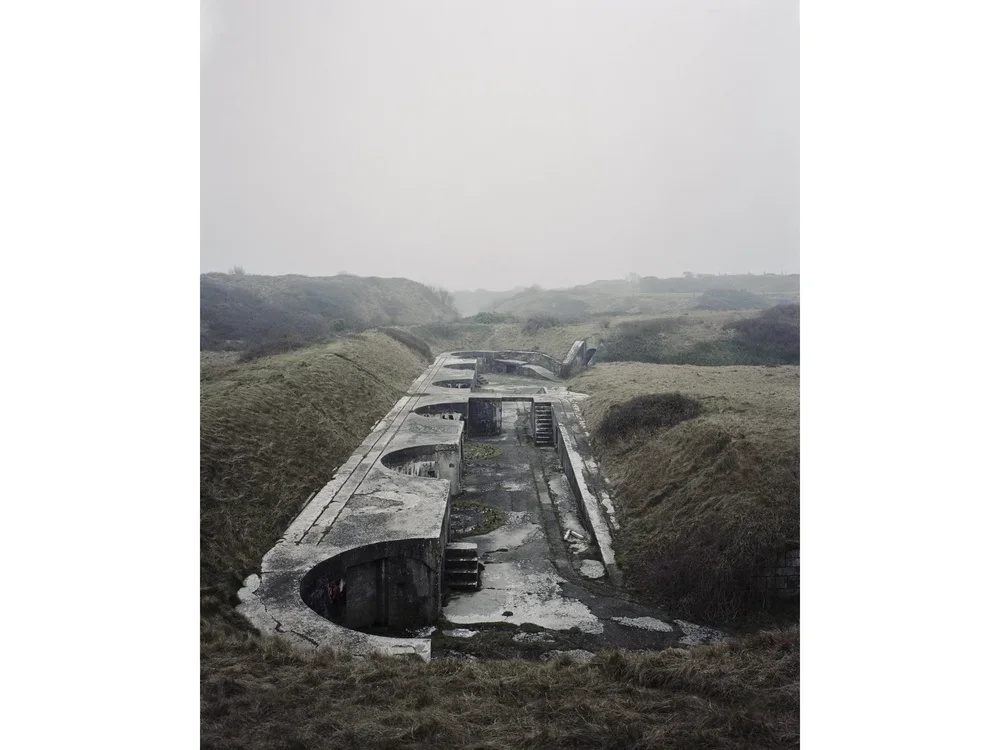
Between 2010 and 2014, Marc Wilson photographed the images comprising The Last Stand, a body of work aimed at encapsulating the narratives and memories of military conflicts embedded within the landscape. This series comprises 91 photographs documenting the enduring relics of the Second World War along the coastlines of the United Kingdom and northern Europe. Focusing on the military defence structures and their integration into the evolving landscape, Wilson sheds light on their significance. Many of these sites have disappeared, either engulfed by shifting sands and waters or altered by human activities. Simultaneously, others have resurfaced from obscurity, unveiling their historical significance.
Over those four years Marc travelled 23,000 miles to 143 locations to capture these images along the coastlines of the UK, The Channel Islands, northern & western France, Denmark, Belgium and Norway.
Marc Wilson’s command of the landscape is admirable and powerful. He is completely reliant on visuals to tell the story of a troubled landscape and it is executed to perfection with atmosphere and composition contributing to a non-verbal commentary on a troubled environment. The collation of these works into photobook form works well with text but I feel there might have been a more interesting way of doing this - perhaps a map of the UK and just the location? That way the image keeps its intrigue and encourages the audience to research what’s so bad about a seemingly abandoned location. One thing that makes the book work seamlessly is the way it has been printed. The book is independently self-published by Wilson’s own two&two press, printed on Colorplan 270 g/m by GF Smith. It is beautifully constructed with a premium feel despite being self-published with the images working on the paper in a visual sense with solid binding.
“It's large format work and it's quite beautiful (Paul Virilio's Bunker Archaeology may be the most recognised photography of sea defences but that's a different kind of book). Everything is shot in subdued diffused light, the pre-dawn it looks like much of the time, and the way in which the different defences merge and crumble into the landscape of which they are now part.
The Last Stand is as multi-layered as the landscapes which it features; there's historical detail wrapped folded over into a chronotopia of functional brutalism, mixed with local touches that feeds into the geological, panoramic and tactical.
All the boxes are ticked in Robert Adams traditional landscape list: there's geography, autobiography, and metaphor. But on top of that, Wilson gives us a politicised view of landscape and power that ties back to survey photography of Timothy O'Sullivan and the work of Mitch Epstein.
Layered into that is an Arcadian vision. With its focus on Northern Europe it's a dystopian Arcadia; there is a pagan feel to Wilson's pictures, a syncretic vision where geology, flora, climate and war find a single expression. And it's beautiful.”
Review courtesy of Colin Pantall
Passage courtesy of Roy Exley (Afterword of The Last Stand by Marc Wilson)
War is a brute and its brutality unleashes energies that are both startling and terrifying. There is nothing subtle about the productivities sponsored by war; commitment is total. Such is the intensity of those unleased energies that wars are, inevitably, historic watersheds - makers in the history of civilisations. In terms of the wider history of mankind they are often brief, but their effects and their traces are, invariably, enduring.
Duration, durability and resistance to decay are, by their very nature, inherent qualities of the edifices thrown up in the service of war. Those monuments, left by wars that we prefer to forget, are rarely celebrated but nethertheless endure - often resisting or skewing those natural processes of growth and decay that are an integral part of the evolution of the landscapes that surround them. The obdurate presence of those monuments effectively punctuates their landscapes, both visually and historically. The remnants of the defensive walls and fortresses of Roman times, on through the castles and fortified bastions of medieval history, right up to the massive defensive structures built by both sides of the conflict that was the Second World War: those scars left by conflict remain.
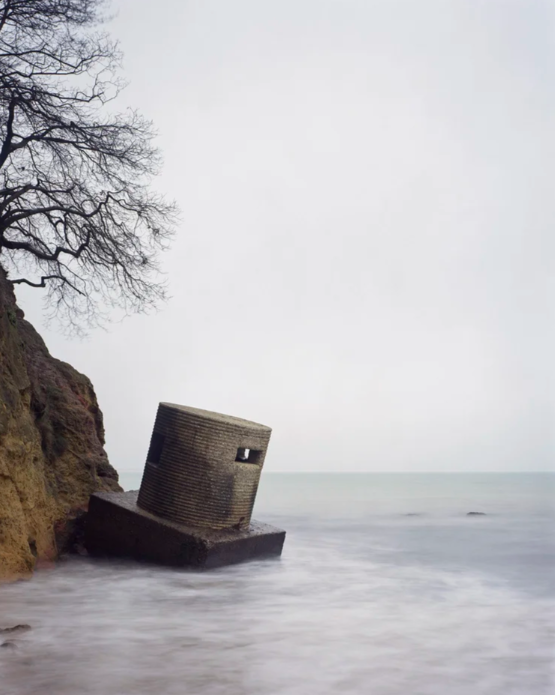
Such is the massive and monolithic nature of these latter bulwarks, that they have resolutely resisted destruction in the decades that have passed since the war’s end. They do, however, have their Achilles heal, which Marc Wilson, in his poignant images of those structures, does not fail to emphasise. Built without foundations - reliant on the massive weight of their centres of gravity for their stability - these structures, through the passage of time, have become unstable through the natural erosion of the coastal sands upon which many of them strand. They have simply tilted, tipped and tumbled in an inevitable submission to the vicissitudes of gravity, coming to rest at crazy angles, their attitudes, but not their structures, altered: a stoic invincibility transformed into a wayward whimsicality. This endurance is, however, relative and ultimately finite, a fact compellingly attested to in Wilson’s photographs.
War is a brute and the nature of its structures and works, by necessity, brutish. The architecture of Hitler’s concrete defences, the Atlantikwall (Atlantic Wall), consisting of somewhere in the region of 15,000 structures created by the Todt Organisation, was inspired by Cyclopean concrete architecture of Friedrich Tamms’ ‘flak towers’ constructed around Berlin, Hamburg and Vienna to protect the cities from Allied bombers. It is uncompromising to the extreme: a chain of monumental sentinels stretching along the maritime fringes of north-west Europe. If these edifices, whose facades are frequently mask-like, had expressions, they might be typified by scowls, their demeanour that of the curmudgeon. These scowling concrete sentries were intended as a deterrent to, as much as a defence against, potential invaders. In the current context their incongruity is striking: they mutely stand guard against bleak and barren stretches of marginal and generally empty littoral landscapes. Sometimes partially - sometimes completely - inundated by dune sands or immured by pioneer woodland, they have not only become irrelevant but also, often, invisible.
In his impressively atmospheric images of The Last Stand series, Wilson has invested these structures with a new life, not so much a resurrection as a re-invention, presented as ‘non-places’ like no other (‘non-place’ in terms of being possessed or frequented by no-one and rendering everyone strangers). The boundaries between perceived contexts and actuality are, in these scenes, often blurred. Are we looking at images of scenes that celebrate the architectural, the archaeological or the geological, or something of each?
Such references are emphasised to different degrees in different images in this series. Also, the littoral environment of which many of these photographs were taken is one that offers its own ambivalence: the strand - sometimes sea, sometimes land - dominates these scenes, offering a further fluidity to that quandary of identity that besets them.
The military machine of the Third Reich attempted possession of land through something that, ultimately, nature would undermine. During the past 4 years, Wilson has journeyed the lengths of Europe’s North-Western coasts tracking the traces and remains of the Atlantikwall, the ghosts left by the grandiose ideas of the Nazi leader and the 12 years of madness they spawned.
The forms of these bunkers, gun emplacements, observation posts and command centres constructed by the Third Reich using copious quantities of poured concrete, defy and eschew any established aesthetic sensibilities: no hint of the classical, the gothic or the baroque here (unless, perhaps, we were to invent the category of the abstract baroque!). Their geometries, purely contingent, were designed to resist the effects of the latest developments in projectile technology, their profiles shaped to deflect such missiles and avoid any direct percussive explosions on their structures.
Those geometries developed out of the direct experiences of combat. In the American Civil War almost a century before, the ironclad warships of both sides - the USS Monitor and the CSS Virginia - had superstructures whose profiles avoided rectilinear, flat, vertical surfaces. The Monitor had a wide, cylindrical design that doubled as gun turret and control centre; the Virginia has a low-profile structure whose sides were raked back at such an angle that any incoming ordnance would be deflected, only to ricochet away harmlessly. In the Battle of Hampton Roads in 1862, both of these vessels fired endless rounds of shells at each other without either succumbing or even being significantly damaged.
Such structural solutions aimed at damage limitation, while not directly imitated, can nethertheless be seen mirrored, subsequently, in the design of those bunkers at the Atlantikwall. There was nothing speculative or arbitrary about the bulwarks of their sometimes bizarre and often ungainly forms: they were purely functional. While far from being graceful or classically proportioned, there is something visually appealing about the alien (and sometimes sinister) forms of these bunkers. Novelty does not quite describe this appeal: more surprise perhaps - a surprise that courts the sublime.
