Rodrigo Braga’s Unusual Approach Presents His Relationship to Landscape and Animals
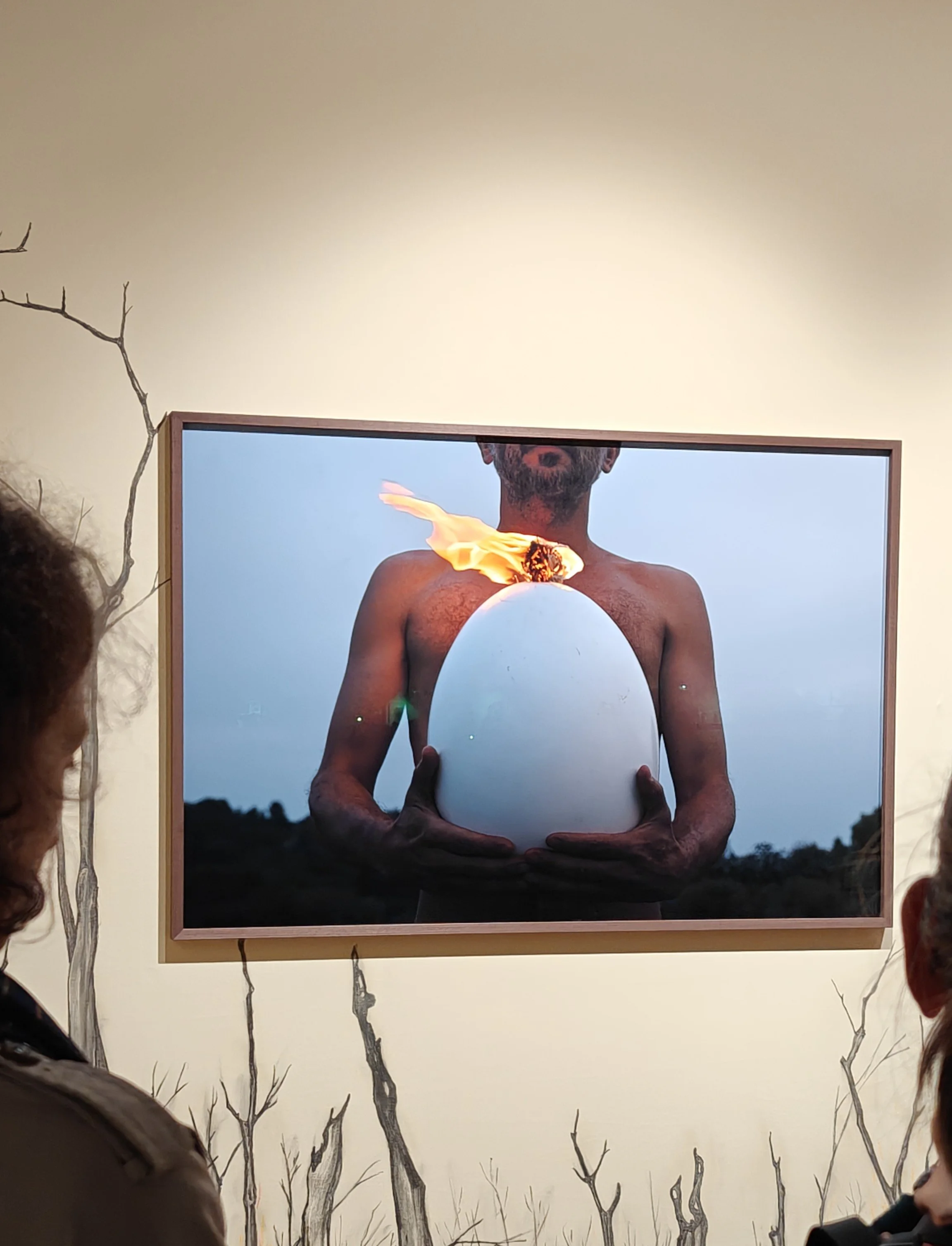
Rodrigo Braga Presenting at Paris Photo. 2025
Born in Manaus in the heart of the Amazon rainforest, Brazilian-born artist Rodrigo Braga confronts the natural world head-on. His video and media-based work are centred on these encounters that place him at the focus point of the work, between the human condition and the animal kingdom.
Braga’s performative practice reveals itself through photography that deals with his relationship with landscape and animals. For Braga, the body is the medium of which he exposes the limits. Power dynamics, weakness, life, death, struggle, submission, domination and masculinity come to play in his practice of photography, video and installation. He tests his limits with any beast, exposing carnal instincts with a calibrated approach.
As a teenager, Rodrigo Braga once found a sick dog while he was on his way to school in Recife, a coastal city in North-Eastern Brazil. He knelt down to look into the animal’s eyes and had something he compares to a nervous breakdown: a flood of tears, accelerated heartbeat and a rush of cold sweat trickling down his skin. That image haunted Braga for the next ten years, until he finally came to terms with his panic attacks and his deep-rooted fear of human interaction.
After years of therapy and medication, Braga’s first work as an artist went back to that pivotal episode. He managed to acquire the body of a dead dog, make a silicone cast of its face and have a veterinary surgeon sew the ears and muzzle to a replica of his own face, recorded in a striking hyper-realist series of photographs suggested a grotesque fusion between man and beast. It was the fake documentation of a real-life encounter that could only exist after the death of one of those involved.
Braga’s response to trauma seems pretty extreme from an external point of view, however we have no idea how the mind of someone with mental health issues operates as everyone is different. He used photography as an outlet to reconnect with himself as a form of therapy and, even though it took a while, he got to a stage where he was able to communicate what was happening in his head without saying it with words. Dystopia is in the process of doing this and it’s important that this reflects me as a person as much as my creative style. The two can co-exist together though - my creative style can say a lot about my personality and what I’m going through in my personal life can impact my approach to photography.
